


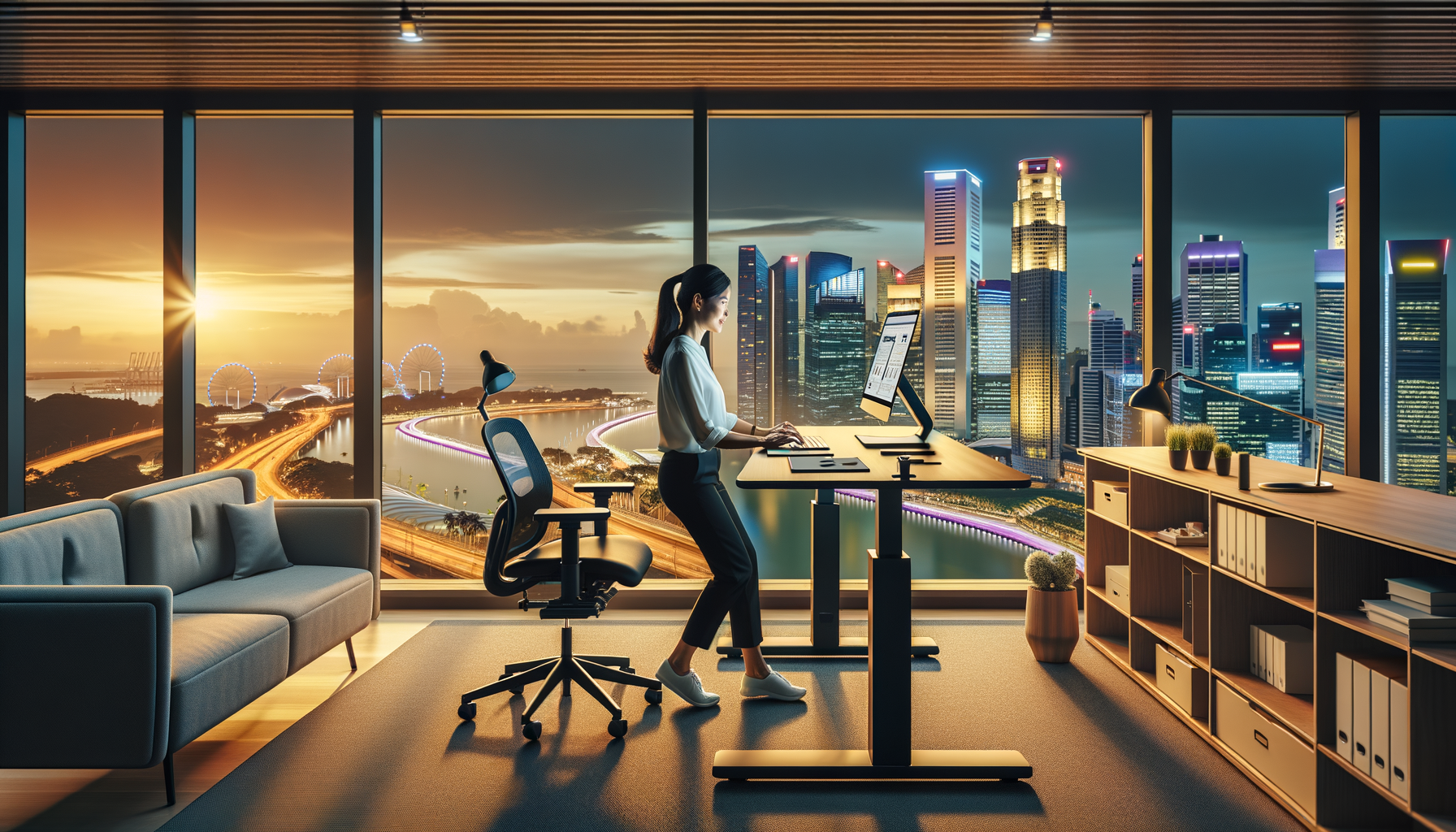
Standing Desk Benefits: A Singapore Office Worker’s Guide to Pain-Free Sitting
Let’s be honest — if you work in Singapore’s CBD, you probably spend 8 to 10 hours a day in an office chair. The aircon is cranked to 16°C, your monitor is at eye level (or it should be), and the only time you get up is to grab your kopi from the pantry.
You’ve heard about standing desks. Maybe your colleague at the next desk has one. Maybe you’ve been thinking about getting one yourself. But the real question is: do they actually help?
The Sitting Problem
Research shows that sitting for more than 8 hours a day increases your risk of lower back pain by 40% — and most Singapore office workers easily clear that mark. When you sit, your spinal discs experience 1.5 times more pressure than when you stand. Lean forward to read your screen? That jumps to nearly 2 times.
From a TCM perspective, prolonged sitting causes qi stagnation and blood stasis (气滞血瘀). Your body’s energy stops flowing freely. Your muscles become stiff. Your lower back — the area most affected — starts sending warning signals.

Why Standing Helps
When you stand, several things happen at once:
- Spinal pressure drops 50% — Your lumbar discs get immediate relief
- Blood circulation improves — Your leg muscles activate and pump blood back toward your heart
- Core engagement begins — Your abdominal and back muscles subtly contract to keep you upright
- Calorie burn increases — You burn about 0.5 more calories per minute standing, roughly 90 extra calories over a 3-hour period
The Right Way to Use a Standing Desk
The biggest mistake people make? They buy a standing desk and try to stand all day. That’s not the point. The goal is alternation, not replacement.
Here’s a practical rhythm that works:
- 25-45 minutes sitting, then 15-20 minutes standing — cycle through this throughout your workday
- Set your screen correctly — top of monitor at eye level, elbows at 90 degrees when typing
- Use a footrest or small box — alternate which foot you rest on to avoid weight imbalance
- Do micro-movements while standing — shoulder rolls, gentle twists, heel raises. Don’t just stand still
- Wear comfortable shoes — high heels and standing desks do not mix
- Prop your laptop on a stack of books or a delivery box — makeshift standing desk in seconds
- Take a 15-minute walk after lunch instead of napping at your desk
- Use a small cup instead of a large water bottle — you’ll walk to the pantry more often
- If you take the MRT, stand on the train instead of hunting for a seat
- Pain in your lower back within 15 minutes of sitting down
- Neck stiffness with audible cracking when you turn your head
- Numbness or tingling down one leg
- Stiffness in the morning that makes it hard to bend over

What If Your Office Doesn’t Have Standing Desks?
Not everyone works in a fancy Raffles Place office with height-adjustable desks. Here are workarounds that actually work:
When to Seek Professional Help
If standing feels more painful than sitting — or if you already have these symptoms — you may need more than a desk adjustment:
These are signs that your muscles and joints need hands-on attention. At San He Tang, our TCM therapists use professional tuina techniques to loosen tight muscles, improve circulation, and restore range of motion. Combined with better work habits — yes, including standing more — most people feel real improvement within a few sessions.
📍 Boon Keng:34 Whampoa West, #01-71A, Singapore 330034
📞 Phone:+65 8191 2134
📍 City Hall:1 Coleman St, The Adelphi #B1-46, Singapore 179803
🕐 Hours:Daily 10AM – 9PM